Most organizations cannot answer a simple question: does the security tooling we already own actually detect the attacks it is supposed to detect?
Breach and attack simulation exists to answer that. It runs known attacker techniques against your live environment, safely, on a schedule, and reports what was caught and what was not.
What It Actually Does
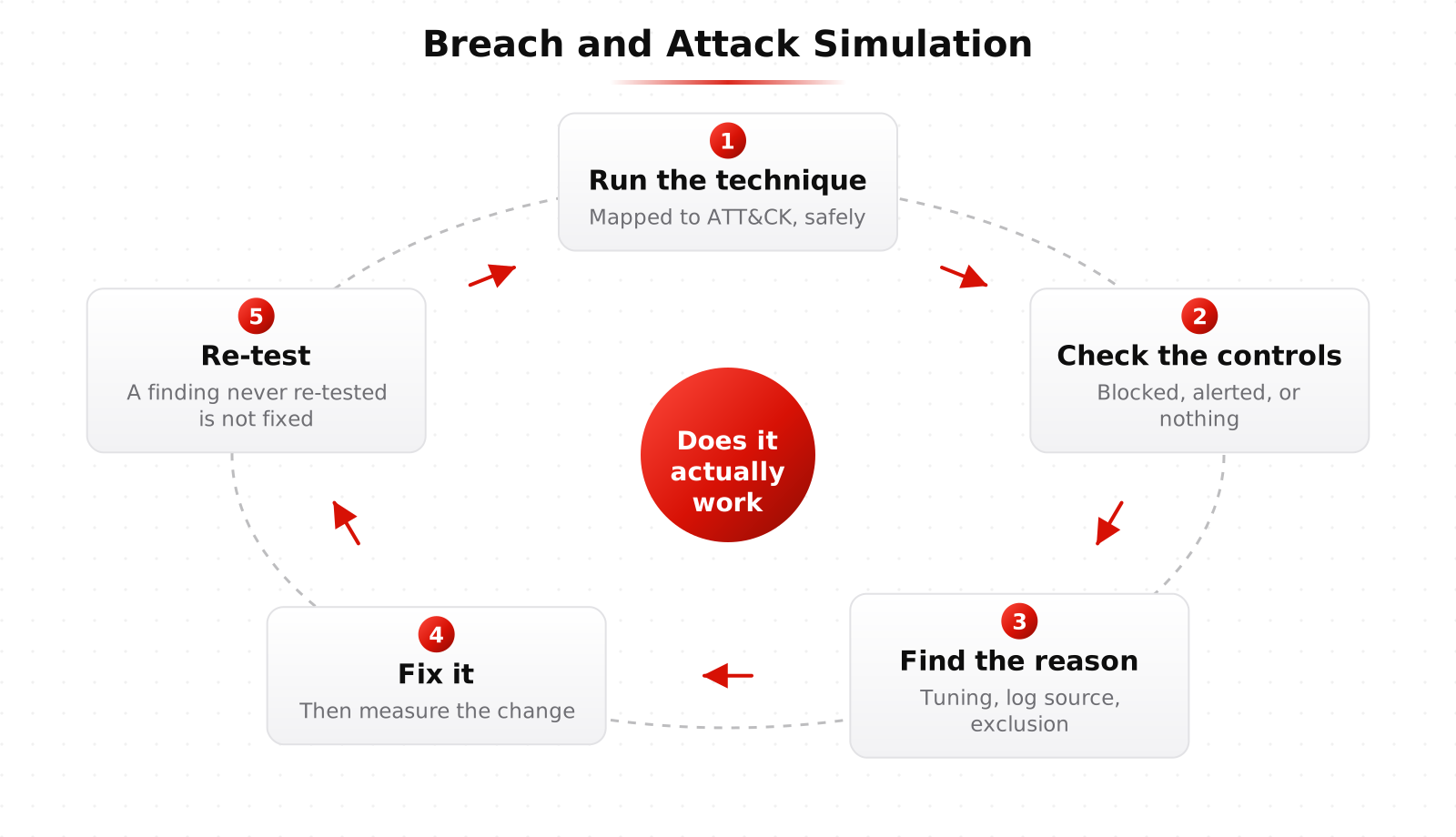
A BAS platform executes techniques mapped to MITRE ATT&CK: attempting credential dumping, creating persistence, moving laterally, simulating data exfiltration, and so on.
Then it checks the result. Did the endpoint tool block it. Did an alert fire in the SIEM. Did anything reach a human. The output is a matrix of techniques against outcomes.
The techniques are executed in a controlled way, using benign stand ins where the real thing would be destructive. The point is testing the control, not causing damage.
What Organizations Find
The findings are consistently more embarrassing than expected, and they follow a pattern.
A tool was deployed but never tuned, so it collects data and alerts on nothing. A log source was never actually enabled on the systems that matter. An exclusion added two years ago for performance reasons covers exactly the servers an attacker would target.
Alerts fire correctly and then die in a queue nobody reads. And detections that were written but never tested turn out to reference a field name that does not exist in production data.
None of that shows up on a dashboard. It only shows up when something actually attacks.
How It Differs From the Alternatives
A vulnerability scanner finds missing patches and misconfigurations. It says nothing about whether you would detect exploitation. See vulnerability management.
A penetration test is a human finding a path, once or twice a year. See penetration testing explained.
Autonomous pentesting chains real attacks toward an objective and proves a path exists. See autonomous pentesting.
BAS is different from all three because it is testing your defenses rather than looking for holes in your systems, and because it runs continuously.
The Vendors
SafeBreach, AttackIQ, Cymulate, and Picus Security are the established names in the category.
Horizon3.ai and Pentera sit adjacent, closer to the autonomous pentesting end. Horizon3 is the platform covered on our breach and attack simulation page.
Starting for Free
Atomic Red Team from Red Canary is a free, open source library of small tests mapped to ATT&CK techniques. Each one is a short script with a clear description of what it does and how to clean up afterwards.
MITRE CALDERA is a free adversary emulation platform that chains techniques automatically.
Running a handful of atomic tests by hand and watching what your tooling does is genuinely eye opening, and it costs nothing but an afternoon in a lab.
Running a Program, Not a Demo
Start with the techniques that matter. Credential access, persistence, lateral movement, and command and control cover the majority of real intrusions.
Fix what fails, then re-test. A finding that is never re-tested is a finding you do not know you fixed. The value of BAS is entirely in the loop.
Tell your SOC, unless you are deliberately testing whether they notice. Both are valid exercises and it is important to know which one you are running.
Track improvement over time rather than a single score. The useful metric is how many techniques moved from undetected to detected this quarter.
Safety
These are real techniques against real systems. Read what a test does before running it, particularly anything touching credentials or persistence.
Be careful in operational technology and legacy environments, where an unexpected crash has physical consequences. Use exclusion lists, run in stages, and start in a test environment where one exists.
Learn This at HackRange
Week 10 of the mentorship covers BAS alongside detection engineering, because testing your detections is the only way to know they are real.