A vulnerability scanner tells you a door might be unlocked. An autonomous pentesting platform opens the door, walks through it, finds the keys on the table, and uses them on the next door.
That difference matters more than it sounds, and it is the reason this category exists separately from scanning.
What These Platforms Do
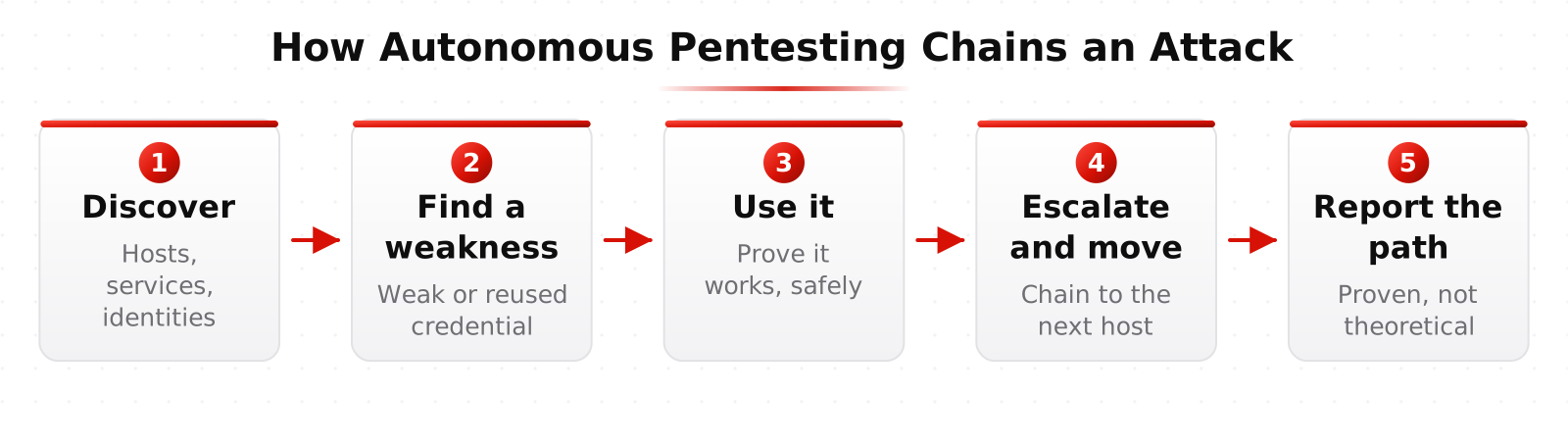
They start from a position inside or outside the network and chain findings the way a human tester would. Find a weak credential, use it, see what it reaches, extract more credentials, escalate, and repeat until they run out of moves.
The output is a proven attack path rather than a list of possible weaknesses. That changes the conversation with management completely. A report saying 47 hosts have a medium severity finding produces a shrug. A report showing that a single expired service account led to domain administrator in four steps produces a meeting.
The best known platforms are Horizon3.ai NodeZero, which we cover on our breach and attack simulation page, and Pentera.
How This Differs From Scanning and From BAS
A vulnerability scanner checks for known conditions and reports them, usually without proving exploitability. See vulnerability management.
Breach and attack simulation runs specific known techniques to test whether your controls detect or block them. It is a test of your defenses. See breach and attack simulation.
Autonomous pentesting is goal directed. It does not run a fixed list, it looks for a path. That makes it the closest automated approximation of what a human tester does, and the noisiest.
What It Is Genuinely Good At
Frequency. A traditional penetration test happens once or twice a year and is out of date within weeks. These platforms can run monthly or weekly, which matches how fast environments actually change.
Consistency. It will check the boring things every single time, including the ones a tired human tester skips in hour thirty of an engagement.
Credential and identity paths. The chained abuse of accounts, group memberships, and cached credentials is highly mechanical and it is where a very large share of real intrusions live.
Proving impact. Automated proof that a path exists ends the argument about whether a finding is theoretical.
What It Cannot Replace
Business logic flaws. An application that lets you change an order after payment, or approve your own expense report, is broken in a way no automated tool recognizes, because it requires knowing what the application is for.
Novel and chained web application vulnerabilities that require understanding intent rather than matching patterns.
Physical and social engineering, which are in scope for many real red team engagements.
Judgment about scope and risk. Deciding what is worth testing, what must not be touched, and what a finding means for this specific business is human work.
The honest framing used in the mentorship is that these tools raise the floor. They handle the repeatable eighty percent so that human testers spend their time on the twenty percent that needs a brain. See penetration testing explained.
Where AI Specifically Comes In
Much of what these platforms do is classic automation rather than machine learning: decision trees, known technique libraries, and graph traversal over discovered relationships. That work predates the current AI wave.
Language models are now being added for the parts that are language shaped. Reading and summarizing findings into a report a manager can act on. Explaining an attack path in plain words. Reasoning about unusual application behavior. Generating variations of payloads.
There is also active research on agents that plan and execute security testing more openly, including public capture the flag benchmarks. Progress there is real and is worth watching, and it is not yet at the point of replacing a skilled tester on a scoped engagement.
Using Them Responsibly
These tools do real things to real systems. Running one against infrastructure you do not own is the same crime as doing it by hand, and having a platform do it does not distribute the responsibility.
Even inside your own environment, scope and timing matter. Credential attacks can lock out accounts. Exploitation can crash fragile systems. Legacy and operational technology environments need particular care, because the consequence of a crash there can be physical.
Every reputable platform has safety controls, exclusion lists, and rate limits. Use them, and tell your own SOC before you start, unless the whole point is to test whether they notice.
Learn This at HackRange
Week 10 of the mentorship covers autonomous pentesting alongside breach and attack simulation, and asks you to validate your own detections against it.