Network access control answers a question that used to have an embarrassing answer: what happens if someone plugs an unknown device into a network port, or joins the wireless with a stolen password?
Without NAC, the answer is usually that they get an address and full access to the segment. With NAC, the network asks who the device is and what it is allowed to do before letting it in.
How It Works at the Port
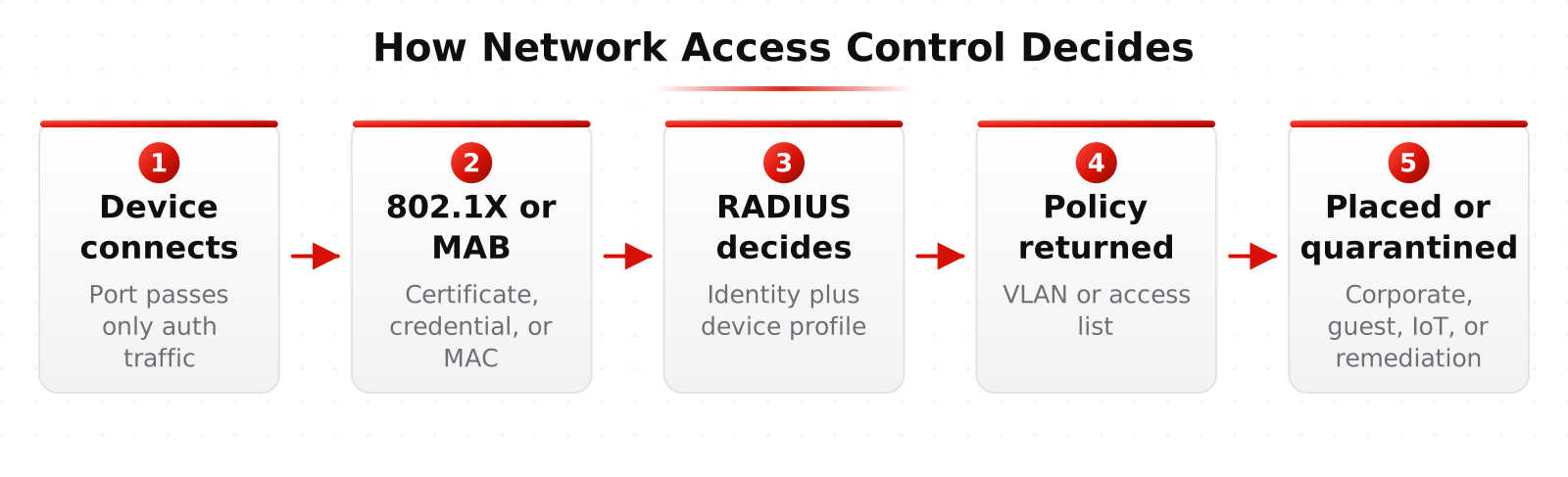
The main standard is IEEE 802.1X, which is port based network access control. Three parties are involved: the device asking to connect, called the supplicant, the switch or wireless controller in the middle, called the authenticator, and a RADIUS server making the decision.
Until authentication succeeds, the port passes only authentication traffic. Once it succeeds, the RADIUS server can return attributes telling the switch what to do, most usefully which VLAN to place the device in or which access list to apply.
That dynamic assignment is the real power of NAC. The same physical port becomes a corporate segment for a managed laptop, a restricted segment for a printer, and a guest segment for a visitor.
Identity for Devices, Not Just Users
Users authenticate with credentials or, better, with certificates issued by your own certificate authority. Certificates are much stronger here because they cannot be phished or shared, though they require a working certificate infrastructure.
Devices authenticate with machine certificates, or by MAC address where nothing better is possible. MAC authentication bypass is weak, because MAC addresses are trivially spoofed, and it exists because printers, cameras, and building controls cannot do anything better.
The practical approach is strong authentication where possible and profiling plus tight segmentation where it is not.
Profiling the Things That Cannot Authenticate
A large share of devices on a modern network are not laptops. Printers, cameras, badge readers, medical equipment, building management systems, and industrial controllers usually have no way to participate in 802.1X.
NAC platforms profile these by fingerprinting behavior: DHCP options, HTTP user agents, MAC address ranges, open ports, and traffic patterns. From that they infer what a device is and apply an appropriate policy.
The security value is enormous and often underrated, because these devices are frequently unpatchable and are a favorite pivot point. Putting every camera in a segment that can reach only its management server is one of the highest value uses of segmentation.
Profiling also produces something most organizations lack, which is an accurate device inventory. See asset management.
Posture Checking
Beyond identity, NAC can ask whether the device is in an acceptable state: is the endpoint agent running, is the operating system patched, is disk encryption on, is antivirus current.
Devices that fail can be quarantined into a remediation segment where they can reach patching infrastructure and nothing else.
Posture is exactly the device signal that zero trust access decisions want, which is why NAC and modern access platforms increasingly share the same posture data.
The Products
Cisco Identity Services Engine, HPE Aruba ClearPass, Forescout, and Fortinet FortiNAC are the established platforms.
PacketFence is a capable open source option, and it is a good way to learn the concepts in a lab without a licensing conversation. On the RADIUS side, FreeRADIUS underpins a great deal of this and is worth knowing directly.
Why NAC Projects Stall
This has a reputation for being one of the most painful deployments in enterprise security, and the reasons repeat.
Nobody knows what is on the network, so enforcement breaks things nobody knew existed. The correct sequence is monitor mode for months, building a device inventory, before enforcing anything.
Legacy devices cannot authenticate and cannot be replaced, so exceptions accumulate until the policy is mostly exceptions.
And the failure mode is highly visible. A NAC misconfiguration takes people offline, which generates immediate pressure to loosen policy. Planning for that politically is as important as planning for it technically.
Getting Value Without a Full Rollout
Run it in monitoring mode and use the visibility alone. Knowing every device on the network is worth the project even before enforcement.
Enforce on wireless and guest first, where the disruption is lower and the risk is high.
Then enforce on wired in the areas that matter most, such as public spaces, conference rooms, and anywhere physically accessible to visitors.
Segment the unmanaged devices even if you never enforce authentication on them. That single step removes a large share of the real risk.
Learn This at HackRange
Week 1 and Week 2 of the mentorship cover addressing, VLANs, and routing, which is the knowledge NAC policy is written against.