GRC has a reputation among technical people as the spreadsheet corner of security. That reputation is unfair and it is also why the roles are easier to get into than the technical ones.
In practice, GRC is the machinery that decides what security work happens, who is accountable, and how anyone outside the team can tell whether it is real.
Governance
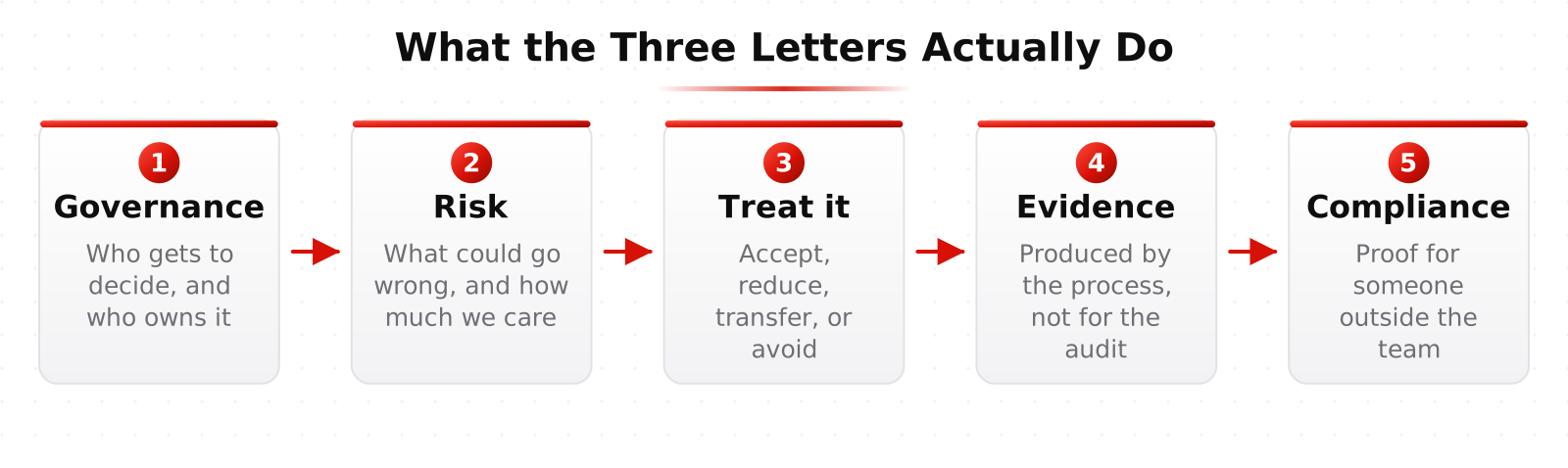
Governance is deciding who gets to decide. It sounds abstract until you watch an organization without it, where security work is set by whoever asked loudest last week.
Concretely it is policies stating what the organization requires, standards saying how, procedures saying who does what, roles with named owners, and a body that reviews and approves exceptions.
The single most useful governance artifact is a decision record: who approved this risk, on what date, with what information. Most disputes during an incident are really disputes about whether anyone ever accepted the risk.
Risk
Risk is being honest about what could go wrong, how likely it is, and how much it would hurt.
The mechanism is a risk register: a list of risks, each with an owner, a description of the scenario, an assessment of likelihood and impact, and a treatment decision.
There are four treatments and only four. Accept it, meaning do nothing and say so out loud. Reduce it, by applying a control. Transfer it, usually through insurance or a contract. Or avoid it, by not doing the thing.
The most common failure is a register full of comfortable numbers, produced to justify decisions already made. That is worse than no register, because it looks like diligence and provides cover.
Risk Appetite, Stated Plainly
Risk appetite is how much risk the organization is willing to carry. It only becomes useful when it is specific.
We accept the risk of an outage of up to four hours in this system is a usable statement. We take security seriously is not.
Getting leadership to state appetite specifically is one of the hardest and most valuable things a GRC function does, because it converts endless argument into a threshold.
Compliance
Compliance is proving to someone outside the team that you did what you said. That someone might be a regulator, a customer, an auditor, or an insurer. See compliance frameworks for who asks for what.
The important distinction, said as often as possible: compliance is not security. It is a floor, written to be assessable across many organizations, which means it is generic by design.
Organizations that treat the audit as the goal build controls that pass tests. Organizations that treat the audit as evidence of a program that already exists find audits much easier.
What Auditors Actually Want
Auditors do not want your opinion, and they are not impressed by tooling. They want evidence that a control operated as described, over a defined period, for the entire population, with no unexplained gaps.
The gap part is where most evidence fails. A report showing patches applied for eleven months of the year raises a question about the twelfth.
Good evidence is generated by the process rather than assembled for the audit. If you have to build it by hand each year, you have a demonstration rather than a control.
Week 5 of the mentorship is built around exactly this problem, described in CIS Controls and audit evidence.
Where Frameworks Fit
A framework is a list somebody else already argued about. The CIS Controls answer what to do first. The NIST Cybersecurity Framework answers how to organize and communicate the whole program. ISO 27001 and SOC 2 answer how to prove it to an outsider.
You do not pick one and reject the others. Most organizations run one control set internally and map it to whatever standards their customers ask about.
GRC as a Career
This is one of the most accessible entry points into security, especially for people coming from audit, finance, project management, or law.
What the work actually rewards is clear writing, comfort asking uncomfortable questions, and enough technical understanding to know when an answer is nonsense. You do not need to write exploits. You do need to know what a patch is and why a firewall rule matters.
The trap is becoming a person who only moves documents. The people who do well pair the process work with real technical literacy, which is why the mentorship teaches the shell alongside the frameworks. See career paths.
Learn This at HackRange
Weeks 4 through 6 of the mentorship are the GRC block, including a challenge where you have to produce audit ready evidence out of deliberately messy data.