The framing of good AI against bad AI makes for a good headline and a bad strategy. Attacks are not won or lost by which side has the better model. They are won or lost by controls.
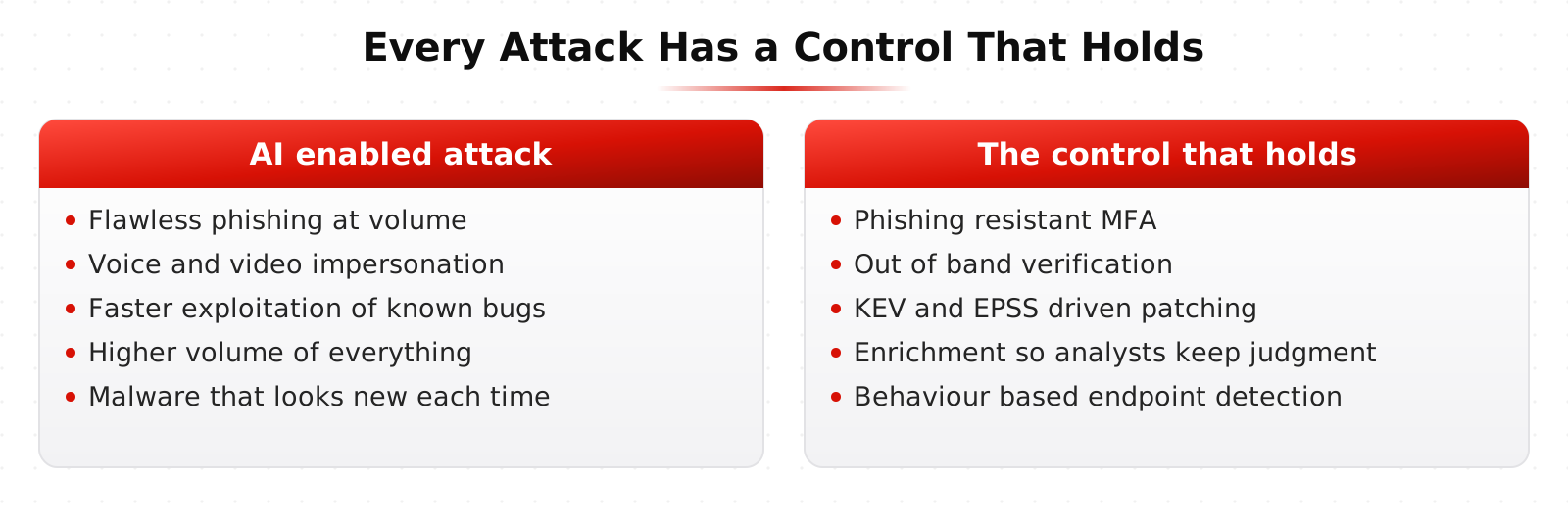
Still, there is a real answer to each AI enabled attack technique, and in several cases the answer does involve AI on the defensive side. Here is the matchup, item by item.
Attack: Flawless Phishing at Volume
The defensive answer is only partly AI. The strongest control is phishing resistant multi factor authentication using hardware keys or passkeys, because it is bound to the real site and cannot be relayed by a convincing fake one. That control does not care how well written the email was.
The AI contribution is on the email gateway. Modern email security scores relationships and behavior rather than just content: has this sender ever emailed this person, does the request match their role, is the reply-to different from the from address, is this a first contact asking for money. Vendors including Abnormal Security and Proofpoint build products around exactly that signal. Detail in AI powered phishing.
Attack: Voice and Video Impersonation
The defensive answer is process, not detection. Out of band verification through a channel and contact detail the requester did not supply. Dual authorization above a threshold. A pre-agreed verification phrase for high value approvals.
Detection tools for synthetic media exist and are improving, and they are worth having as a secondary signal. They are not worth relying on as a primary control, because the generators improve at least as fast as the detectors.
Attack: Faster Exploitation of Known Vulnerabilities
The defensive answer is a vulnerability management program that prioritizes correctly and moves quickly on the small number of things that actually matter. The CISA Known Exploited Vulnerabilities catalog and the EPSS exploit prediction scores are both free and both better prioritization signals than CVSS alone.
AI helps here with the reading. Turning a vendor advisory into a plain statement of whether it affects your specific configuration is a text task, and doing that across dozens of advisories a week is exactly the sort of volume problem it handles well. See vulnerability management.
Attack: Higher Volume of Everything
The defensive answer is the SOC use case: enrichment and summarization so analysts spend their attention on judgment rather than gathering. That is covered fully in AI in the SOC.
The trap to avoid is using AI to close alerts automatically because the queue is long. That converts a visible problem, an unmanageable queue, into an invisible one, missed detections.
Attack: Malware That Looks Different Every Time
The defensive answer predates AI entirely. Behavior based endpoint detection watches what a process does rather than what it looks like, and machine learning has been part of those products for years. CrowdStrike, SentinelOne, and Microsoft Defender for Endpoint all work this way.
Changing a binary does not change the need to establish persistence, escalate, or call home. See EDR and XDR explained.
Where Defensive AI Genuinely Leads
Anomaly detection on identity behavior. Impossible travel, unusual access patterns, a service account suddenly behaving interactively, or a user touching data they have never touched. These are statistical problems on data you own, which is the ideal case.
Code review at scale. Running an assistant over a codebase to flag candidates for human review finds real issues, particularly in code nobody has looked at in years. Every finding still needs verification, which is fine, because triage is cheaper than discovery.
Log parsing and normalization. Getting a strange log format into a usable shape used to be a half day of regular expressions. It is now often minutes.
Documentation and knowledge. Answering what does our policy say about this, or which of our systems uses this library, when the answer is buried in documents nobody has read.
The Controls That Do Not Care About AI at All
It is worth listing these plainly, because they are where most of the value sits and none of them are new. Asset inventory. Patching what is exposed. Phishing resistant authentication. Least privilege. Network segmentation. Backups that are tested and offline. Logging the right sources. Practicing incident response before you need it.
None of those care how an attack was authored. An organization that does these well is in decent shape against AI enabled attackers. An organization that does not will not be saved by buying an AI security product. That is the same conclusion the CIS Controls reached before any of this.
A Realistic Adoption Order
First, write the acceptable use policy and pick approved tools with contracts that cover your data. Doing this after adoption means arguing with people who already depend on something.
Second, use AI for analyst assistance, meaning enrichment, explanation, and drafting, where the human stays in the loop and the failure mode is visible.
Third, use it for scale problems that were previously ignored entirely, such as reviewing old code or reading every advisory.
Last, and carefully, consider anything that takes action automatically. Start with actions that are cheap to undo, log everything, and sample the results regularly to see whether it is actually doing what you think.
Learn This at HackRange
The mentorship covers both halves of this: using AI as a defender in Week 11, and governing how the rest of the company uses it in Week 7.